Posts

Simply put: Klages et al. (2020)
Image
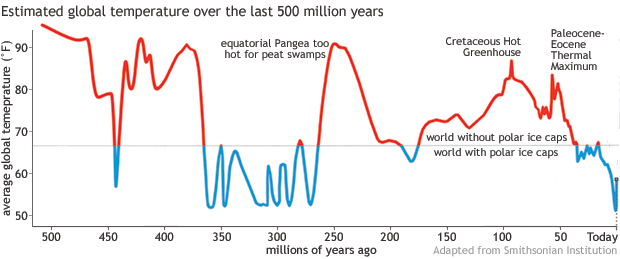
Paleoclimate science -- or the science of the climates of the past -- sometimes tells us truly confounding things about how the world was before we arrived on the scene. Here I describe (for the layman) the findings of a study by a group of paleoclimatologists who studied the climate of the Cretaceous Period. This post is based on the paper " Temperate rainforests near the South Pole during peak Cretaceous warmth " by Klages et al. (2020), published in Nature. As the title gives away, the mid-Cretaceous was so warm that there were rainforests near the South Pole! Now if I have your attention, let's explore. Some context The Earth has seen several warm periods in its past. Take a look at how the global temperature is thought to have varied over the last 500 million years. (50 ℉ = 10 ℃. 90 ℉ = 32.2 ℃ . No, I did not choose the scale for the y-axis.) Note where the Cretaceous Hot Greenhouse is marked in the plot below. Klages et al. (2020) focused on the time period betwee...

Why Paleoclimate Modelling?

I am interested in paleoclimate modelling. What does that mean and why should anyone attempt it? There are a few things I need to discuss before I attempt to answer that question.  The concept of "climate" is like the air we breathe. We already have systems in place which depend on it, but as long as it is everywhere and fresh, and our systems work smoothly, we are not really required to give much thought to it. However, when trouble arises, we are required to develop an understanding of it, however alien and complicated this task might seem. "Climate" does not mean "weather"; a climatologist and a meteorologist are not the same, nor can they possibly be. These are two different trades requiring different backgrounds, skills and motivations. Weather is short-term, climate is long-term. We would be wasting our time by mistaking the two for each other. Climate models are useful and a good thing. Since unfamiliarity can also breed contempt, people often ...

Simply put: Hausfather et al. (2019)

Image
This post is based on the paper " Evaluating the Performance of Past Climate Model Projections " by Hausfather et al. (2019) published in Geophysical Research Letters. It explores an important question: How well did early climate models capture climate change?   Image source   Note that this study focused on a previous generation of climate models. Today, these models are operationally obsolete, i.e. they are no longer used for climate projections as they have been superseded by improved and more advanced models. But results from these modelling studies provide outputs for long timeframes. For examples, the oldest studies considered (Manabe, 1970; Mitchell, 1970 and Benson, 1970) provide data for 30 years from 1970 to 2000. In contrast, at the time this paper was being written, the newest study included (from the IPCC Assessment Report 4) provided only 10 years of data from 2007 to 2017. So even if this study does not tell us, How well do current climate models capture climat...